

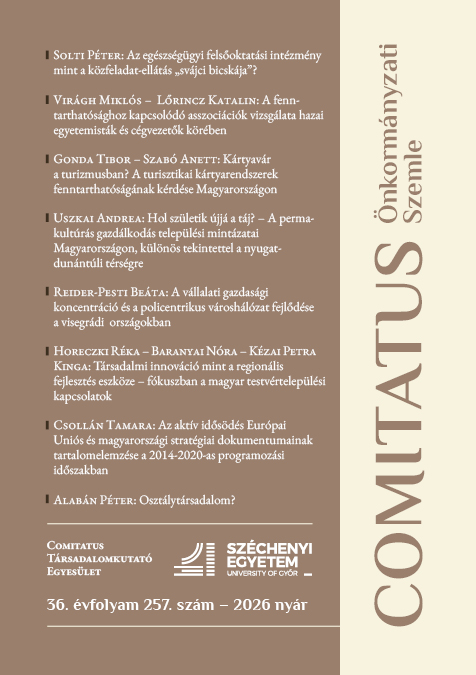
Hol születik újjá a táj? – A permakultúrás gazdálkodás települési mintázatai Magyarországon
| LETÖLTÉS | DOI: 10.59809/Comitatus.2026.36-257.69 |
|
Szerző: Uszkai Andrea, tudományos munkatárs, ELTE Közgazdaság- és Regionális Tudományi Kutatóközpont, Regionális Kutatások Intézete, 9022 Győr, Liszt Ferenc u. 10., uszkai.andrea@krtk.elte.hu, JEL kód: Q15, Q57 Kulcsszavak: permakultúra, Nyugat-Dunántúl, területi terjedés, település |
Author: Andrea Uszkai, Research Fellow, ELTE Centre for Economic and Regional uszkai.andrea@krtk.elte.hu, JEL kód: Q15, Q57 Keywords: permaculture, Western Transdanubia, spatial spread, settlement |
Absztrakt:
A permakultúra olyan holisztikus tervezési és gazdálkodási megközelítés, amely a természeti rendszerek működéséből merítve törekszik fenntartható emberi tevékenységek kialakítására, különös tekintettel az élelmiszertermelésre. Napjainkban a klímaváltozással összefüggő kihívások kezelésének, valamint a vegyszermentes élelmiszer előállításának lehetőségei egyre inkább előtérbe kerülnek hazánkban is, támogatva a permakultúra mint környezetkímélő gazdálkodási forma népszerűségének növekedését. Jelen tanulmány célja ezen gazdálkodási forma mint elsősorban innováció hazai terjedésének vizsgálata térségi összevetésben, településtípusok szerint, kiemelt figyelmet fordítva a társadalmi-gazdasági eltérésekre, kiegészítve néhány gyakorlati példával a nyugat-dunántúli régióból. A kutatás egy 2025-ben 106 fő részvételével készült online kérdőíves felmérésen alapul, amely egyebek mellett a gazdálkodók demográfiai jellemzőit, motivációit, a gazdaság méretét, értékesítési csatornáit elemezte. A tanulmány arra a következtetésre jut, hogy a permakultúrás gyakorlatok jelentős társadalmi és térbeli diverzitást mutatnak, ami fontos alapot szolgáltathat a jövőbeli szakpolitikai és közösségi támogatási rendszerek célzottabb kialakításához.
Abstract:
Permaculture is a holistic approach to design and management that draws on the functioning of natural systems to foster sustainable human activities, with a particular focus on food production. Today, the challenges associated with climate change and the potential for chemical-free food production are increasingly coming to the forefront in Hungary as well, contributing to the growing popularity of permaculture as an environmentally friendly form of farming. The aim of this study is to examine the spread of this form of farming—primarily as an innovation—through a regional comparison by settlement type, with a particular focus on socioeconomic disparities, and to supplement it with several practical examples from Western Transdanubia. The research is based on an online questionnaire survey conducted in 2025 with 106 participants, which analysed, among other things, farmers’ demographic characteristics, motivations, farm size, and sales channels. The study concludes that permaculture practices exhibit significant social and spatial diversity, which can provide an important foundation for the more targeted design of future policy and community support systems.
IRODALOMJEGYZÉK
Balázs Bálint – Balogh Lili – Réthy Katalin: Az agroökológia magyarországi helyzetének és szereplőinek feltérképezése (2019–2020), Védegylet, Budapest, 2020/62, 6–9.
Barthel, Stephan – Folke, Carl – Colding, Johan: Social–ecological memory in urban gardens–Retaining the capacity for management of ecosystem services, Global Environmental Change, 2010/2, 255–265. https://doi.org/10.1016/j.gloenvcha.2010.01.001
Centeri, Csaba – Saláta, Dénes – Szilágyi, Alfréd – Orosz, György – Czóbel, Szilárd, – Grónás, Viktor – Gyulai, Ferenc – Kovács Eszter – Pető, Ákos – Skutai, Julianna – Biró, Zsolt – Malatinszky, Ákos: Selected Good Practices in the Hungarian Agricultural Heritage, Sustainability, 2021/12, 6676. https://doi.org/10.3390/su13126676
Farkas Orsolya – Szalmáné Csete Mária: Természetvédelmi értékek meghatározási folyamata, múltja, jelene és jövője, Tájökológiai Lapok – Journal of Landscape Ecology, 2023/1, 3–19. https://doi.org/10.56617/tl.4886
Ferguson, Rafter Sass – Lovell, Sarah Taylor: Permaculture for agroecology: Design, movement, practice, and worldview. A review, Agronomy for Sustainable Development, 2014/2, 251–274. https://doi.org/10.1007/s13593-013-0181-6
Ferguson, Rafter Sass – Lovell, Sarah Taylor: Grassroots engagement with transition to sustainability: Diversity and modes of participation in the international permaculture movement, Ecology and Society, 2015/4, 39. http://dx.doi.org/10.5751/ES-08048-200439
Gál Izóra – Szalai Magdolna Zita – Divéky-Ertsey Anna – Pusztai Péter: Permakultúra és ökológiai gazdálkodás jelentése és oktatása a MATÉ-n, in: Bujdosó Zoltán (szerk.): XVIII. Nemzetközi Tudományos Napok: A „zöld megállapodás” – Kihívások és lehetőségek: Előadások és poszterek összefoglalói, Gyöngyös, Magyarország: Magyar Agrár- és Élettudományi Egyetem Károly Róbert Campus, 2022, 54.
Hemenway, Toby: Gaia’s garden: A guide to home-scale permaculture, Chelsea Green Publishing, 20092.
Holmgren, David: Permaculture: Principles and pathways beyond sustainability, Holmgren Design Services, 2002.
Kallis, Giorgos – Paulson, Susan – D’Alisa, Giacomo – Demaria, Federico: The case for degrowth, Polity Press, 2020, 21. p.
Kézai Petra – Konczosné Szombathelyi Márta: A rurális innováció európai és hazai mintái, Tér-Gazdaság-Ember, 2021/1, 51–75. https://tge.sze.hu/tge/article/view/242
Kopnina, Helena – Blewitt, John: Sustainable business: Key issues, Routledge, 2018, 318 p. https://doi.org/10.4324/9781315110172
Maye, Damian: Examining Innovation for Sustainability from the Bottom up: An Analysis of the Permaculture Community in England, Sociologia Ruralis, 2018/2, 331–350. https://doi.org/10.1111/soru.12141
Mollison, Bill: Permaculture: A designer’s manual, Tagari Publications, 1988, 600 p.
Mollison, Bill – Holmgren, David: Permaculture one: A perennial agriculture for human settlements, Tagari Publications, 1981, 128 p.
Oliveira, Hugo – Penha-Lopes, Gil: Permaculture in Portugal: Social-Ecological Inventory of a Re-ruralizing Grassroots Movement, European Countryside, 2020/1, 30–52. https://doi.org/10.2478/euco-2020-0002
Oroczo-Meléndez, José Francisco – Paneque-Gálvez, Jaime: A role for grassroots innovation toward agroecological transitions in the Global South?, Evidence from Mexico, Ecological Economics, 2022, 201. https://doi.org/10.1016/j.ecolecon.2022.107582
Popovici, Elena-Ana – Damian, Nicoleta – Grigorescu, Ines – Persu, Mihaela: Indicator-based analysis of organic farming in Romania. Regional spatial patterns, International Journal of Agricultural Sustainability, 2021/5, 874–891. https://doi.org/10.1080/14735903.2021.2008194
Szörényiné Kukorelli Irén: Vidéki térségeink innovációt befogadó képessége – Egy kutatás tapasztalatai, Tér és Társadalom, 2015/1, 97–115. https://doi.org/10.17649/TET.29.1.2686
Uszkai, Andrea: Sustainable Urban Food Production with a Special Focus on Permaculture from Hungarian Perspectives, Planning, 2025(a)/1, 123–133. https://doi.org/10.14744/planlama.2025.80847
Uszkai Andrea: Környezetkímélő mezőgazdasági formák összehasonlító elemzése, Falu, 2025(b)/3, 31–48.
Veteto, James R. – Lockyer, Joshua: Environmental Anthropology Engaging Permaculture: Moving Theory and Practice Toward Sustainability, Culture & Agriculture, 2008/1–2, 47–58. https://doi.org/10.1111/j.1556-486X.2008.00007.x
INTERNETES FORRÁSOK
European Commission: Agriculture and the Green Deal – A healthy food system for people and planet, 2024a. Elérhető: https://commission.europa.eu/strategy-and-policy/priorities-2019-2024/european-green-deal/agriculture-and-green-deal_en (Letöltés ideje: 2026.04.18.)
European Commission: Common Agricultural Policy (CAP) 2023–27, 2024b. Elérhető:https://agriculture.ec.europa.eu/cap-2023-27_en (Letöltés ideje: 2026.04.18.)
Eco-villages. From dream to reality: Gyűrűfű, the first ecovillage in Hungary, 2018. Elérhető:https://eco-villages.eu/en/2018/06/21/from-dream-to-reality-gyurufu-the-first-ecovillage-in-hungary/ (Letöltés ideje: 2026.04.18.)
Gyurufu.net. History of Gyűrűfű permaculture courses, 2024. Elérhető: https://www.gyurufu.net/permaculture-history (Letöltés ideje: 2026.04.18.)
Központi Statisztikai Hivatal: Magyar Statisztikai Évkönyv, Népesség-és társadalomstatisztika, 2024. Elérhető: https://www.ksh.hu/evkonyvek/2024/magyar-statisztikai-evkonyv-2024/pdf/statevk2024_2.pdf (Letöltés ideje: 2026.04.18.)
Magyar Permakultúra Egyesület: Urban permaculture initiatives in Budapest, 2024. Elérhető: https://permakultura.hu (Letöltés ideje: 2026.04.18.)
Plantura.garden: What is permaculture?, Definition and benefits. Elérhető: https://plantura.garden/uk/gardening-tips/permaculture/what-is-permaculture (Letöltés ideje: 2026.04.15.)
Simonitsné Krausz Dóra: Permakultúra – Mit kell tudni róla?, 2020. Elérhető: https://agroforum.hu/blog/haz-taj/mit-kell-tudni-a-permakulturarol/ (Letöltés ideje: 2026.04.18.)
Szabó, Sára: A self-sufficient garden: why permaculture is becoming increasingly fashionable in our country, 2024. Elérhető: https://hellohungary.hu/en/did-youknow/a-self-sufficient-garden-why-permaculture-is-becoming-increasingly-fashionable-in-our-country (Letöltés ideje: 2026.04.18.)