

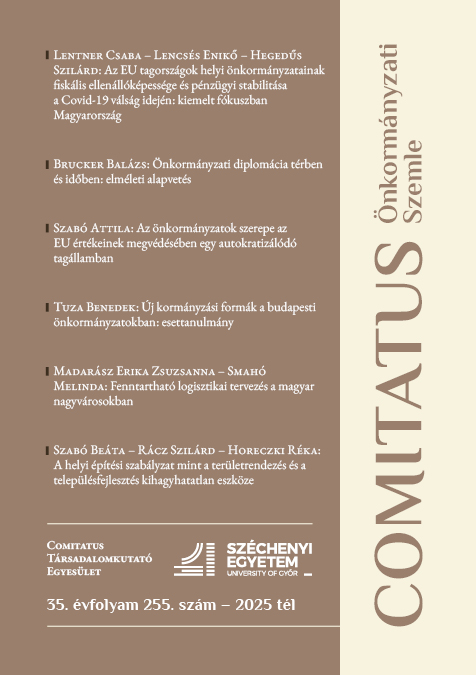
Új kormányzási formák a budapesti önkormányzatokban: esettanulmány
| LETÖLTÉS | DOI: 10.59809/Comitatus.2025.35-255.67 |
|
Szerző: Tuza Benedek, tudományos segédmunkatárs, PhD hallgató, HUN-REN CSFK Földrajztudományi Intézet, ELTE TTK Társadalom- és Gazdaságföldrajzi Tanszék, bentuza73@gmail.com, ORCID: 0009-0003-9185-6110
Kulcsszavak: együttműködésen alapuló kormányzás, társadalmi innováció, részvétel, Budapest |
Author: Benedek Tuza, Research Assistant, PhD Student, HUN-REN CSFK Institute of Geography ELTE Faculty of Science, Department of Social and Economic Geography, bentuza73@gmail.com, ORCID: 0009-0003-9185-6110
Keywords: collaborative urban governance, social innovation, participatory planning, Budapest |
Absztrakt: A tanulmány a budapesti önkormányzatokban kibontakozó részvételi folyamatok intézményesült formáit vizsgálja. Célja, hogy feltárja, miként járulhatnak hozzá a különböző szervezeti modellek a társadalmi igazságosság és a fenntartható fejlesztések előmozdításához. Az elemzés tágabb kereteit a collaborative urban governance (együttműködésen alapuló kormányzás) és társadalmi innováció szakirodalma adja. A kutatás tizenhat félig strukturált mélyinterjún alapul, amelyek során önkormányzati tisztviselőket, civil szervezetek képviselőit és szakértőket szólaltattam meg. A vizsgálat négy kerület (III., VIII., XII. és XIII.) gyakorlatát elemezte, amelyek eltérő szervezeti megoldásokkal – a hivatalba integrált részvételtől a dedikált részvételi irodákig – igyekeznek bevonni a lakosságot a döntéshozatalba. Megállapítható, hogy a lakosság minél széleskörűbb részvételének megszervezése nem csupán az önkormányzatok demokratikus kötelezettsége, hanem a helyi közösségek megerősítésének és a fenntartható városfejlesztésnek alapfeltétele. A kutatás rámutat, hogy hosszú távon a dedikált közösségi részvételi irodák jelenthetik a leghatékonyabb modellt, amelyek platformként képesek összekapcsolni a lakosságot, a civileket és az önkormányzati döntéshozókat – ettől függetlenül persze minden olyan törekvés, amely a valódi részvétel megteremtésére irányul, hatékonyabb városfejlesztést és egy igazságosabb demokratikus intézményrendszert segít elő.
Abstract: This paper examines the institutionalized forms of participatory processes emerging in local governments in Budapest. The paper explores how different organizational models can contribute to advancing social justice and sustainable development. The broader analytical framework is provided by the literature on collaborative urban governance and social innovation. The research is based on sixteen semi-structured interviews conducted with municipal officials, civil society representatives, and urban planning experts. The analysis focuses on the practices of four districts (III, VIII, XII, and XIII), which employ different organizational solutions – from participation integrated into the municipal administration to dedicated participatory offices – to involve residents in decision-making. The findings indicate that organizing the broadest possible citizen participation is not merely a democratic obligation of municipalities but also a prerequisite for strengthening local communities and achieving sustainable urban development. The study highlights that in the long run, participatory offices may represent the most effective model, serving as platforms that connect residents, civil society actors, and municipal decision-makers. Nevertheless, all initiatives aiming to establish genuine participation contribute to more effective urban development and more just democracy.
IRODALOMJEGYZÉK
Ágh Attila: A védekező társadalom, avagy a civilek hatalma: töprengések a magyar civil társadalom helyzetéről, Civil Szemle, 2016/1, 5–29.
Baker, Susan – Mehmood. Abid: Social Innovation and the Governance of Sustainable Places, Local Environment, 2015/3, 321–334. https://doi.org/10.1080/13549839.2013.842964
Bond, Sophie – Thompson-Fawcett, Michelle (2007): Public Participation and New Urbanism: A Conflicting Agenda?, Planning Theory & Practice, 2007/4, 449–472. https://doi.org/10.1080/14649350701664689
Bródy Luca Sára: Társadalmi részvétel a városfejlesztésben: változó szerepek Budapest tereinek alakításában, Tér és Társadalom, 2022/1. 82–99. https://doi.org/10.17649/TET.36.1.3359
Considine, Mark – Lewis, Jenny M.: Bureaucracy, Network, or Enterprise?, Comparing Models of Governance in Australia, Britain, the Netherlands, and New Zealand, Public Administration Review, 2003/2, 131–140. https://doi.org/10.1111/1540-6210.00274
Chambon, Jean-Louis – David, Alix – Devevey, Jean-Marie: Les innovations sociales, Paris, 1982.
Csanádi Gábor – Csizmad Adrienne – Kőszeghy Lea: Nyilvánosság és részvétel a településtervezési folyamatban, Tér és Társadalom, 2010/1, 15–36. https://doi.org/10.17649/TET.24.1.1293
Della Porta, Donatella – Diani, Mario: Social Movements: An Introduction, Malden, USA; Oxford, UK; Victoria, Australia: Blackwell Publishing Ltd., 20062.
Durkheim, Emile: The Division of Labor in Society (trans. Lewis A. Coser), New York, 1997.
Emerson, Kirk – Nabatchi, Tina – Balogh, Stephen: An Integrative Framework for Collaborative Governance, Journal of Public Administration Research and Theory, 2011/1. https://doi.org/10.1093/jopart/mur011
Finta István (2019): Lakossági igények, lakossági elégedettség és a helyi önkormányzati együttműködések közötti összefüggések a közszolgáltatások területén, Comitatus, 2019/233, 47–58.
Gerometta, Julia – Hartmut Haussermann – Longo, Giulia: Social Innovation and Civil Society in Urban Governance: Strategies for an Inclusive City, Urban Studies, 2005/11, 2007–2021. https://doi.org/10.1080/00420980500279851
Göymen, Korel – Sazak, Onur (eds.): Centralization decentralization debate revisited, Instanbul, 2014.
Grant, Jill L.: A Difficult Balancing Act”: What Planning Involves, Planning Theory & Practice, 2022/5, 724–740. https://doi.org/10.1080/14649357.2022.2109719
Henderson, Hazel: Social Innovation and Citizen Movements, Futures, 1993/3, 322–338. https://doi.org/10.1016/0016-3287(93)90140-O
Horváth, Dániel – Keresztes-Sipos, Andrea – Lukácsházi, Gergely – Avar, Zoltán – Virág, Dániel Benedek – Hámori, Péter: Navigátor: kézikönyv a társadalmi bevonáshoz, Budapest Főváros Önkormányzata, 2018.
Jessop, Bob: Liberalism, Neoliberalism, and Urban Governance: A State–Theoretical Perspective, Antipode, 2002/34, 452–472. https://doi.org/10.1111/1467-8330.00250
Kooiman, Jan: Governing as Governance, London, 2003. https://doi.org/10.4135/9781446215012
Kőszeghy, Lea – Hilbert, Bálint – Csizmady, Adrienne (2025): Urban Planning in the Context of Democratic Backsliding: The Case of Hungary, in: Listerborn, Carina – Grange, Kristina (eds.): The Role of Planning in ‘Anti-Democratic’ Times, Urban Planning, 2025/10. https://doi.org/10.17645/up.9893
Ladner, Andreas – Keuffer, Nicolas – Baldersheim, Harald: Measuring local autonomy in 39 countries (1990–2014), Regional and Federal Studies, 2016/3, 321–357. http://doi.org/c4ck
Meerkerk, Joachim: Understanding the Governing of Urban Commons: Reflecting on Five Key Features of Collaborative Governance in Zero Waste Lab, Amsterdam, International Journal of the Commons, 2024/1, 397–410. https://doi.org/10.5334/ijc.1282
Moulaert, Frank – Martinelli, Flavia – Swyngedouw, Erik: Social Innovation, Governance, and Community Building – SINGOCOM, Final Report Month 40, European Union Framework V, Key Action Improving Socio-economic Knowledge Base, Contract No. HPSE-CT2001-00070, Project No. SERD- 2000-0028, Brussels, 2005.
Moulaert, Frank: Social Innovation: Institutionally Embedded, Territorially (Re)Produced, in: MacCallum, Diana – Moulaert, Frank – Hillier, Jean – Haddock, Vicari S. (eds.): Social Innovation and Territorial Development, 2009, 11–23. Farnham and Burlington: Ashgate.
Mould, Oli: Tactical Urbanism: The New Vernacular of the Creative City, Geography Compass, 2014/8, 529–539. https://doi.org/10.1111/gec3.12146
Newman, Janet: Modernising Governance: New Labour, Policy and Society, London, 2001.
Pálné Kovács Ilona: A magyar önkormányzatok korlátai a helyi gazdaságfejlesztésben, Tér és Társadalom, 2019/2, 3–19. https://doi.org/10.17649/TET.33.2.3088
Portugali, Juval: Self-organization and the city, Heidelberg–Berlin, 2000.
Phills, James A. – Deiglmeier, Kriss – Miller, Dale T.: Rediscovering social innovation, Stanford Social Innovation Review, 2008/4, 34–44.
Ross, Michael: Is democracy good for the poor?, American Journal of Political Science, 2006/50, 860–874. https://doi.org/10.1111/j.1540-5907.2006.00220.x
Stoker, Gerry: Governance as theory: 5 propositions, International Social Science Journal, 2008/155, 17–28. https://doi.org/10.1111/1468-2451.00106
Swyngedouw, Erik: Governance Innovation and the Citizen: The Janus Face of Governance-beyond-the-State, Urban Studies, 2005/11, 1991–2006. https://doi.org/10.1080/00420980500279869
Talen, Emily: Do-it-Yourself Urbanism: A History, Journal of Planning History, 2015/2, 135–148. https://doi.org/10.1177/1538513214549325
Taylor, Marilyn: Community Participation in the Real World: Opportunities and Pitfalls in New Governance Spaces, Urban Studies, 2007/2, 297–317. https://doi.org/10.1080/00420980601074987
Thörn, Hakan – Mayer, Margit – Thörn, Catharina (2016): Re-thinking Urban Social Movements, ‘Riots’ and Uprisings: An Introduction, in: Mayer, Margit – Thörn, Catharina – Thörn, Hakan (eds.): Urban Uprisings, London, 3–55. https://doi.org/10.1057/978-1-137-50509-5_1
Touchton, Michael – Wampler, Brian: Improving Social Well-Being Through New Democratic Institutions, Comparative Political Studies, 2013/10, 1442–1469. https://doi.org/10.1177/0010414013512601
Tuza, Benedek: A kulturális gazdaság szerepe a Bartók-negyed kialakulásában és fejlődésében, Tér és Társadalom, 2024/2, 130–147. https://doi.org/10.17649/TET.38.2.3528
Tuza Benedek – Kovács Zoltán: A részvételi demokrácia kihívásai a városfejlesztésben: budapesti tapasztalatok, Civil Szemle, 2024/4, 133–150. https://doi.org/10.62560/csz.2024.04.7